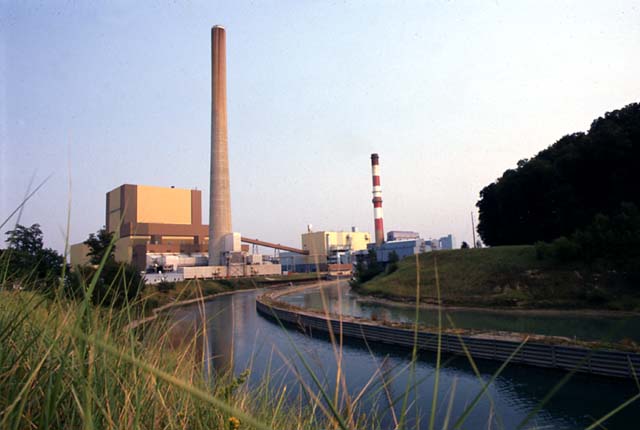
A massive battery storage plant has a major impact on a locality’s safety profile, property values, and other aspects. As noted here, “one BESS has the explosive power of 17 tons of dynamite with a blast radius of 2 miles and an evacuation radius of 5 miles due to toxic fumes which could contain hydrogen sulfide, hydrogen fluoride, phosphoryl fluoride and hydrogen cyanide. A Type 1 HAZMAT team should be available in every community a BESS is located. These teams have a $4 million start up cost and cost $2 million annually to maintain.” The dangers are real: “Lithium ion batteries are capable of spontaneous ignition and subsequent explosion from overheating…BESS fires have occurred in the U.S. at the McMicken (Sunrise, AZ) and Mt Elden (near Flagstaff, AZ) facilities. The Kauku Wind Facility had two fires near Oahu, Hawaii, and Franklin, Wisconsin, experienced a fire at a project assembling the BESS. South Korea experienced 23 BESS fires over a year and a half period, causing the government to halt new installations and urging operators to curtail their use in 2019. Not all operators complied, resulting in five more fires.” There are additional hazards as well. Residential property values are mal-affected.
Many people in Blendon Township were recently shocked and appalled to learn of a planned battery plant planned in their township, along with its negative implications. Blendon Bulletin does an excellent job of chronicling what Blendon Township has experienced and learned through the process.
Consumers Energy would also like to locate a battery storage site where the Campbell plant is now located, as reported in the Guardian and stated by Consumers Energy representatives in local public meetings.
This shows the evacuation zone of the planned Blendon Township battery plant: https://www.facebook.com/story.php?story_fbid=25163860683204522&id=100000218120050&mibextid=wwXIfr&rdid=5basE38t0iWllnBy#
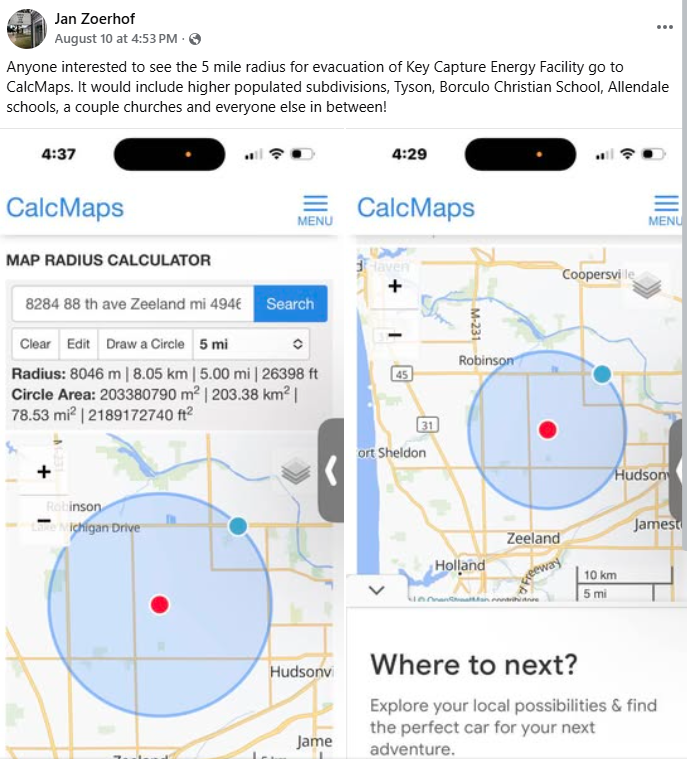
This shows the 5-mile evacuation zone radius map of the planned battery storage site where the Campbell plant now sits:
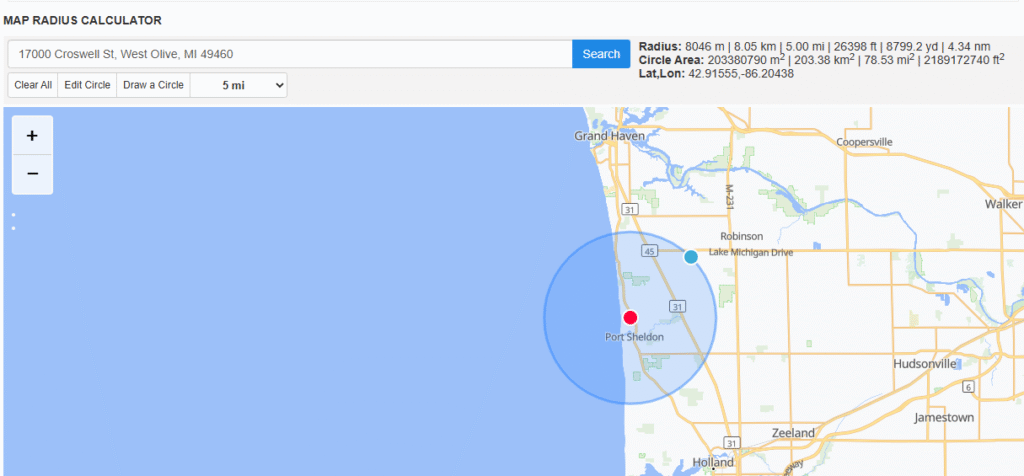
This second battery plant would seem to affect parts of Port Sheldon, Olive, Robinson, and Grand Haven Townships.
Have all of those located in these evacuation zones been informed of the planned battery plants and their negative implications? Have they been informed of the hazards and the effect on their property values? Do most Ottawa County citizens realize many more battery plants will likely come in the attempt to replace coal and gas plants with solar/wind/battery, and do they realize the negative implications?
This is all so unnecessary, because such dangerous massive battery storage plants are not needed but a waste of money for ratepayers if we simply stick with a combination of gas and coal as our baseload electric. The gas/coal plant combination can adjust electric generation to match demand, unlike solar/wind. Many Ottawa County residents are unaware of the dangers of these massive battery plants, and they are also unaware that even with these massive battery storage plants solar and wind still cannot realistically provide reliable electric energy at least for the coming decade as our baseload electric.
“Save The Campbell” is fighting to keep a sane energy policy for Ottawa County, starting with our county’s Campbell plant.